CausalBGM - An AI-powered Bayesian generative modeling approach for causal inference in observational studies
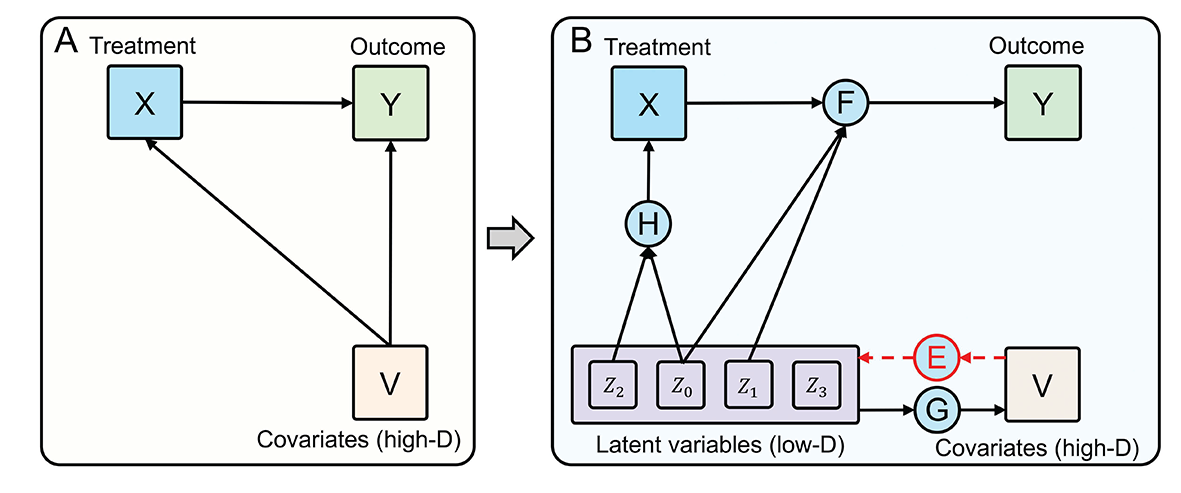
CausalBGM is an innovative Bayesian generative modeling framework tailored for causal inference in observational studies with high-dimensional covariates and large-scale datasets.
It addresses key challenges by leveraging Bayesian principles and advanced AI techniques to estimate average treatment effects (ATEs) and individual treatment effects (ITEs) with robust uncertainty quantification.
CausalBGM applicability
Point estimates of counterfactual outcomes, ATE, ITE, ADRF, and CATE.
Posterior interval estimates for counterfactual outcomes, ATE, ITE, ADRF, and CATE.
Support for both continuous and binary treatment settings.
Method highlights
CausalBGM combines Bayesian causal inference with AI techniques for principled and scalable causal effect estimation.
CausalBGM adopts an encoding generative modeling (EGM) initialization strategy for stable training.
CausalBGM outperforms leading causal inference methods in various settings.
Quickstart
import yaml
import numpy as np
from bayesgm.models import CausalBGM
from bayesgm.datasets import Sim_Hirano_Imbens_sampler

params = yaml.safe_load(open("src/configs/Sim_Hirano_Imbens.yaml", "r"))
x, y, v = Sim_Hirano_Imbens_sampler(N=20000, v_dim=200).load_all()

# Instantiate a CausalBGM model
model = CausalBGM(params=params, random_seed=None)

# Train the CausalBGM model with EGM initialization and iterative updating algorithm
model.fit(data=(x, y, v), epochs=200, epochs_per_eval=10, use_egm_init=True, egm_n_iter=30000, egm_batches_per_eval=500, verbose=1)

# Make predictions using the trained CausalBGM model
causal_pre, pos_intervals = model.predict(
    data=(x, y, v),
    alpha=0.01,
    n_mcmc=3000,
    x_values=np.linspace(0, 3, 20),
    q_sd=1.0,
)
Main references
Qiao Liu and Wing Hung Wong (2025), An AI-powered Bayesian generative modeling approach for causal inference in observational studies. JASA (in press).
Qiao Liu, Zhongren Chen, and Wing Hung Wong (2024), An encoding generative modeling approach to dimension reduction and covariate adjustment in causal inference with observational studies. PNAS.