User guide
bayesgm is a toolkit providing a AI-driven Bayesian generative modeling framework for various Bayesian inference tasks in complex, high-dimensional data.
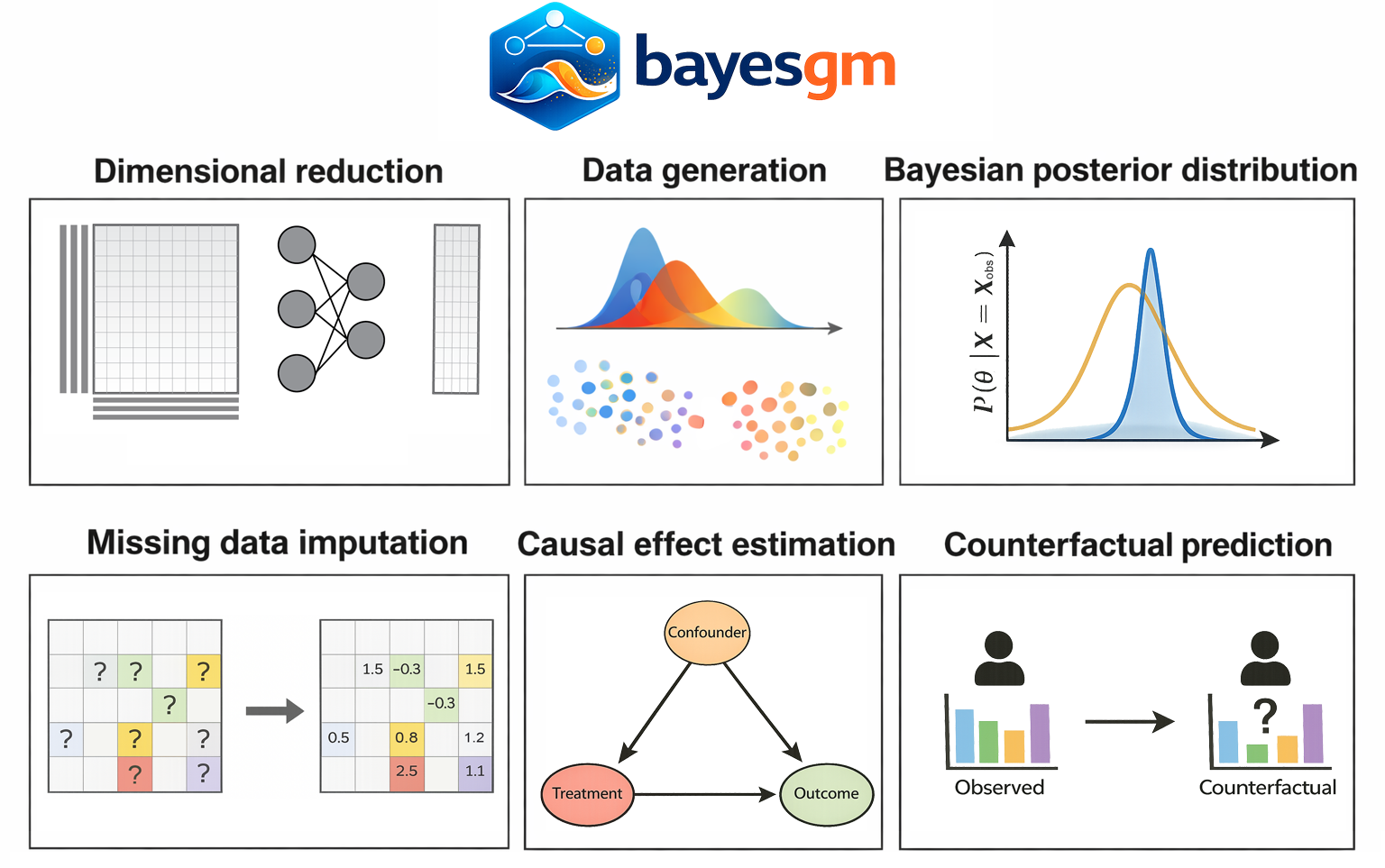
The figure below illustrates the versatility of bayesgm, spanning dimensional reduction, data generation, Bayesian posterior inference, missing-data imputation, causal effect estimation, and counterfactual prediction:
Which model should I use?
Use BGM family if your goal is:
conditional prediction/generation
missing-data imputation
dimension reduction
Use CausalBGM family if your goal is:
counterfactual prediction
ATE estimation
ITE estimation
Package overview
All models are installed from the same bayesgm package:
pip install bayesgm
Core namespaces:
bayesgm.modelsfor model classes (BGM,CausalBGM, etc.)bayesgm.datasetsfor built-in simulation/semi-synthetic samplersbayesgm.utilsfor helpers and data IO
Next steps:
Follow the Installation page in this section.
Open the BGM or CausalBGM section in the sidebar.
Start from the model quickstart block, then continue to tutorials.